A great softball team can have strong pitchers, powerful hitters, and dependable infielders, but if the outfield is constantly giving away extra bases, making communication mistakes, or playing afraid of the ball, those weaknesses will eventually show up on the scoreboard.
The good news? A great young softball outfield doesn’t happen because you find three naturally gifted athletes and put them in the grass.
It is built.
Young outfielders can become incredibly reliable defenders when coaches teach them the right fundamentals, give them plenty of repetitions, and create an environment where players learn to trust themselves and each other.
Building an unstoppable young softball outfield isn’t about making every player perfect. It’s about creating three players who know exactly what to do, communicate with one another, attack the ball, and understand that every outfield ball is an opportunity to help their team.
Here’s how to build that kind of outfield.
1. Teach Your Outfielders That Defense Wins Games

Young players naturally love hitting.
They love stepping into the batter’s box, getting a big hit, stealing bases, and scoring runs.
Defense isn’t always as exciting.
That’s why coaches need to change the way young players think about playing the outfield.
Don’t tell your outfielders that their job is simply to “catch fly balls.”
Their job is to prevent hits from becoming extra-base hits.
Their job is to back up teammates.
Their job is to communicate.
Their job is to save runs.
Their job is to make the pitcher feel confident throwing strikes because she knows there are three defenders behind her ready to make plays.
When players understand the importance of their position, they start taking ownership of it.
A young outfielder should eventually walk onto the field thinking:
“Nothing is getting past me.”
That mindset is incredibly valuable.
2. Put the Right Player in the Right Position
Not every outfielder is built the same.
Some players have tremendous speed.
Some have excellent instincts.
Some have strong throwing arms.
Some are fearless when attacking the ball.
Some are incredibly good at tracking fly balls.
When building your outfield, pay attention to these qualities.
Center Field
Your center fielder should generally be one of your best defensive athletes.
Center field covers a tremendous amount of territory, so speed and instincts are extremely important.
Your center fielder should be able to communicate with both corner outfielders and take charge on balls hit into the gaps.
Left and Right Field
Your corner outfielders still need speed, athleticism, and confidence.
Don’t treat left field or right field as a place to hide a weaker defensive player.
Instead, use those positions to develop players.
A young player who struggles with fly balls can become an excellent outfielder with proper instruction and repetition.
The goal is to develop three dependable defenders rather than one great defender surrounded by two players who are afraid of the ball.
3. Teach the Ready Position

Before the pitch, your outfielders shouldn’t be standing flat-footed with their hands on their knees.
They should be ready to move.
Teach them to stay athletic.
Feet should be roughly shoulder-width apart.
Knees should be slightly bent.
Weight should be on the balls of their feet.
Hands should be in a comfortable position where they can react quickly.
Most importantly, their eyes should be on the batter.
This ready position allows an outfielder to react immediately when the ball comes off the bat.
It seems like a small detail, but small details become big advantages.
4. Teach the First Three Steps
One of the biggest differences between an average outfielder and a great outfielder is what happens immediately after contact.
Young players often take a bad first step.
They hesitate.
They turn the wrong direction.
They run backward.
They wait to see where the ball is going.
Those wasted steps can turn an easy catch into a difficult one.
Teach your players to react aggressively.
When the ball is hit, they should immediately determine whether it is coming toward them, away from them, or directly over their head.
Then they need to move.
A great drill is the coach fungo or soft toss reaction drill.
Have the outfielder begin in the ready position.
Hit balls in different directions.
Don’t worry about making every ball difficult.
The goal is to teach the player to react immediately.
Over time, those first three steps become automatic.
5. Teach Players to Get Behind the Ball
One of the most important defensive habits an outfielder can develop is getting behind the ball.
If the ball is hit directly toward them, they shouldn’t simply run to the spot where they think it will land.
They should work to get their body behind the ball whenever possible.
Why?
Because sometimes the ball takes a bad bounce.
Sometimes the player misjudges it.
Sometimes the ball gets knocked out of the glove.
If the player is behind the ball, there is a much better chance she can keep the ball in front of her.
If she is running sideways and the ball gets past her, the hitter may suddenly have an extra-base hit.
Teach your players:
Catch the ball whenever possible. Keep the ball in front of you when you can’t.
That simple principle can save runs.
6. Teach Proper Fly-Ball Technique
Young players need a consistent method for catching fly balls.
Teach them to move their feet first and get their body underneath the ball.
As the ball comes down, they should work toward a balanced position rather than reaching wildly.
Their glove should be positioned where they can see it and the ball at the same time.
They should squeeze the glove after contact and immediately secure the ball.
And here’s a huge coaching point:
Don’t let young players become afraid of dropping the ball.
If a player is terrified of making a mistake, she will hesitate.
If she understands that mistakes are part of learning, she will attack the ball.
Confidence creates better defense.
7. Teach Communication Early
This is one of the biggest differences between a good outfield and a great outfield.
Your players have to communicate.
And they have to communicate loudly.
Young players often assume someone else will make the play.
That is when collisions happen.
That is when balls drop between players.
That is when everybody stands around looking at each other.
Teach your outfielders simple communication commands.
For example:
“Mine!”
“You!”
“Back!”
“In!”
“Cut!”
The player who has the best chance to make the catch needs to take charge.
Don’t make communication complicated.
Simple, loud, consistent communication wins.
8. Teach the Center Fielder to Take Charge
Your center fielder can become the communication leader of the outfield.
That doesn’t mean she has to be the team’s loudest personality.
It means she needs to understand the responsibility of her position.
On balls hit into the gaps, the center fielder should communicate with the corner outfielders.
The goal is to eliminate hesitation.
If two players are both trying to catch the same ball, someone needs to take charge.
If nobody calls it, everyone is guessing.
Teach your center fielder that communication is part of playing the position.
9. Practice Balls Hit Between Players
One of the best ways to build communication is to deliberately hit balls between outfielders.
Put your three outfielders in position.
Hit balls between them.
At first, make the balls easy.
Then gradually increase the difficulty.
Make the players communicate before making the catch.
If the ball belongs to the center fielder, she should call it.
If the corner outfielder has the better angle, she should call it.
The players need to learn that communication isn’t something they do only during games.
It is a skill they practice.
10. Teach Players to Attack Ground Balls
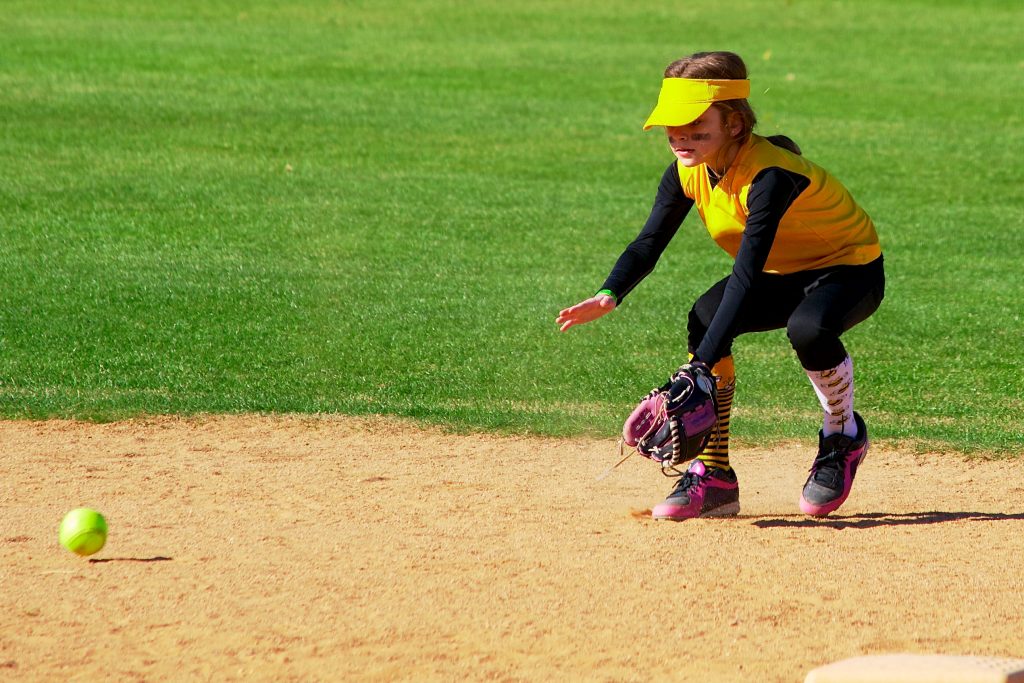
Young outfielders often wait for ground balls to reach them.
Teach them to attack.
When a ball is hit into the outfield, the player should move aggressively toward it whenever appropriate.
Getting to the ball quickly reduces the hitter’s opportunity to take an extra base.
It also gives the outfielder more momentum for her throw.
A great drill is the “charge and throw” drill.
Hit ground balls into the outfield.
Have the player charge the ball, field it cleanly, get into throwing position, and make an accurate throw to a target.
Don’t focus only on throwing distance.
Focus on getting the ball back quickly and accurately.
11. Develop Strong Throwing Fundamentals
A strong outfield arm is useful.
But an accurate arm is even more valuable.
Young players should learn proper throwing mechanics early.
Teach them to:
- Get their feet moving toward the target.
- Use proper arm action.
- Step toward the target.
- Follow through.
- Make strong, accurate throws.
Don’t let young players believe they need to throw as hard as possible every time.
A 45-mph throw that reaches the right player is much more valuable than a 55-mph throw sailing over the cutoff player’s head.
Accuracy first.
Arm strength will develop with age, practice, and proper mechanics.
12. Make the Cutoff Player a Priority
Outfielders aren’t playing alone.
The cutoff player is a critical part of the defense.
Young outfielders need to understand where they are throwing the ball before they pick it up.
Teach them to look for the cutoff player.
They should know whether the play is going to second base, third base, or home.
Don’t wait until game day to teach this.
Practice it.
Hit balls into the outfield.
Have runners advance.
Teach your outfielders to find the cutoff player quickly and make the throw.
The faster the outfielder gets the ball to the cutoff player, the more opportunities the defense has to stop runners.
13. Practice Situations, Not Just Skills
This is where many youth practices fall short.
Coaches spend 30 minutes hitting fly balls but never teach players what to do with the ball after they catch it.
Your outfield practice should include game situations.
For example:
Runner on first.
Ball hit to right field.
What does the right fielder do?
Where does the cutoff player go?
Where does the second baseman go?
Where does the center fielder go?
What happens if the ball gets past the right fielder?
Now repeat the situation.
Change the runner.
Change the location of the hit.
Make the players think.
The goal is to make game situations feel familiar.
14. Teach Backup Responsibilities
Great outfielders don’t just make plays.
They back up teammates.
When a throw is going toward the infield, other players need to understand where they should be.
When a ball is hit into another outfielder’s territory, nearby players should know their backup responsibilities.
These details prevent big mistakes.
A young player might think:
“That’s not my ball.”
A great defender thinks:
“If she misses it, where do I need to be?”
That is a completely different defensive mindset.
15. Use Repetition to Build Confidence
Young athletes don’t become confident because a coach tells them they’re good.
They become confident because they’ve successfully performed a skill hundreds of times.
Give your outfielders repetitions.
Fly balls.
Ground balls.
Line drives.
Balls over their heads.
Balls in front of them.
Balls into the gaps.
Communication drills.
Throwing drills.
Cutoff drills.
Backup drills.
The more situations they see, the more comfortable they become.
Eventually, the game slows down for them.
That’s when you start seeing big improvements.
16. Make Practice Competitive
Young players love competition.
Use it.
Divide your outfielders into teams.
Award points for clean catches.
Award points for good communication.
Award points for accurate throws.
Award points for backing up correctly.
Create situations where players have to make decisions.
You can even create a “defensive inning.”
Put runners on base and hit balls into the outfield.
The defense earns points for preventing runners from advancing.
Now your players aren’t just catching balls.
They’re competing.
And they’re learning how defensive decisions affect the game.
17. Teach Players How to Handle Mistakes
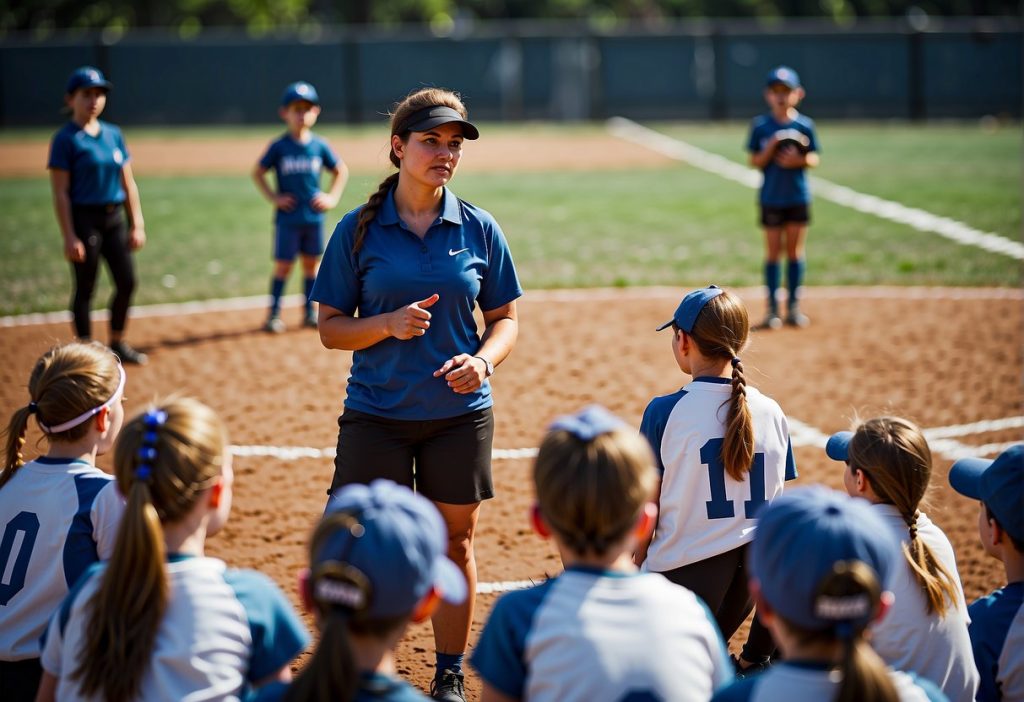
This might be one of the most important parts of developing young outfielders.
They are going to drop balls.
They are going to misjudge fly balls.
They are going to make bad throws.
They are going to miss cutoff players.
It happens.
Don’t allow one mistake to turn into three.
Teach players to reset immediately.
Drop the ball?
Find the ball.
Make the throw.
Get ready for the next pitch.
Bad throw?
Forget it.
Get back into position.
Great players aren’t players who never make mistakes.
Great players recover quickly.
18. Build an Outfield That Trusts Each Other
Trust is everything.
Your left fielder needs to trust your center fielder.
Your center fielder needs to trust your right fielder.
Your right fielder needs to trust the cutoff player.
And everyone needs to trust the player beside them.
That trust comes from practice.
When players repeatedly communicate, make plays, and back each other up, confidence grows.
Eventually, they stop thinking:
“I hope she gets it.”
They start thinking:
“We’ve got this.”
That change is powerful.
19. Don’t Forget the Mental Side of Outfield Defense
Outfielders can go long stretches without touching the ball.
That’s dangerous for young players.
They get distracted.
They start talking.
They stop paying attention.
Then suddenly a ball is hit directly toward them.
Teach your outfielders to stay mentally involved every pitch.
They should know:
- How many outs there are.
- Where the runners are.
- Who is batting.
- Where the play might be.
- Where they need to throw the ball.
- What their backup responsibility is.
A prepared outfielder is much more likely to make a big play.
20. Create an Outfield Identity
Give your outfield something to believe in.
Maybe your team’s defensive identity is:
“Nothing Drops.”
Maybe it’s:
“Three Outfielders. One Wall.”
Or:
“Attack Every Ball.”
Whatever you choose, make it something the players understand.
When young athletes feel like they’re part of something, they often begin holding themselves accountable.
Your outfield shouldn’t simply be three girls standing in left, center, and right.
It should become a unit.
A team within the team.
21. A Simple Outfield Practice Routine
You don’t need fancy equipment to develop a great outfield.
Here’s a simple practice structure coaches can use.
Warm-Up — 10 Minutes
Start with throwing progression and dynamic movement.
Get players moving and prepare their arms.
Ground Balls — 10 Minutes
Hit routine ground balls.
Teach players to approach the ball aggressively, field it cleanly, and make accurate throws.
Fly Balls — 15 Minutes
Start with routine fly balls.
Progress to balls in front, behind, and to both sides.
Communication — 10 Minutes
Hit balls between outfielders.
Require players to communicate loudly.
Cutoff and Relay — 10 Minutes
Add runners.
Teach players where to throw and how to use the cutoff.
Game Situations — 15 Minutes
Create realistic scenarios.
Put runners on base.
Change the number of outs.
Change the location of the hit.
Make players think.
Competition — 10 Minutes
Finish with a defensive competition.
Keep score.
Make it fun.
The Biggest Secret: Develop Aggressive Defenders
If I could give a young softball coach one piece of advice about building an outfield, it would be this:
Teach your players to attack the game.
Don’t build an outfield full of players who are afraid to make mistakes.
Build an outfield full of players who want the ball.
When a fly ball goes into the gap, you want your players moving.
When a ground ball is hit, you want them charging.
When a ball is hit toward another outfielder, you want communication.
When a teammate misses a ball, you want the next player backing her up.
When a mistake happens, you want everyone resetting for the next pitch.
That’s what an unstoppable outfield looks like.
Final Thoughts
Building an unstoppable young softball outfield doesn’t happen overnight.
It takes repetition, patience, communication, confidence, and good coaching.
Start with the fundamentals.
Teach your players how to get into position.
Teach them how to read the ball.
Teach them how to move their feet.
Teach them how to catch.
Teach them how to throw.
Teach them how to communicate.
Then take those individual skills and turn them into a defensive system.
Most importantly, give your young players permission to be aggressive.
Let them chase the ball.
Let them make mistakes.
Let them learn.
Celebrate the player who makes the difficult catch just as much as the player who hits the game-winning home run.
Because when your outfielders begin believing that every ball hit their direction belongs to them, something changes.
They stop playing defense.
They start owning the outfield.
And when three confident, aggressive, communicating outfielders take the field together, your softball team becomes a whole lot tougher to beat.