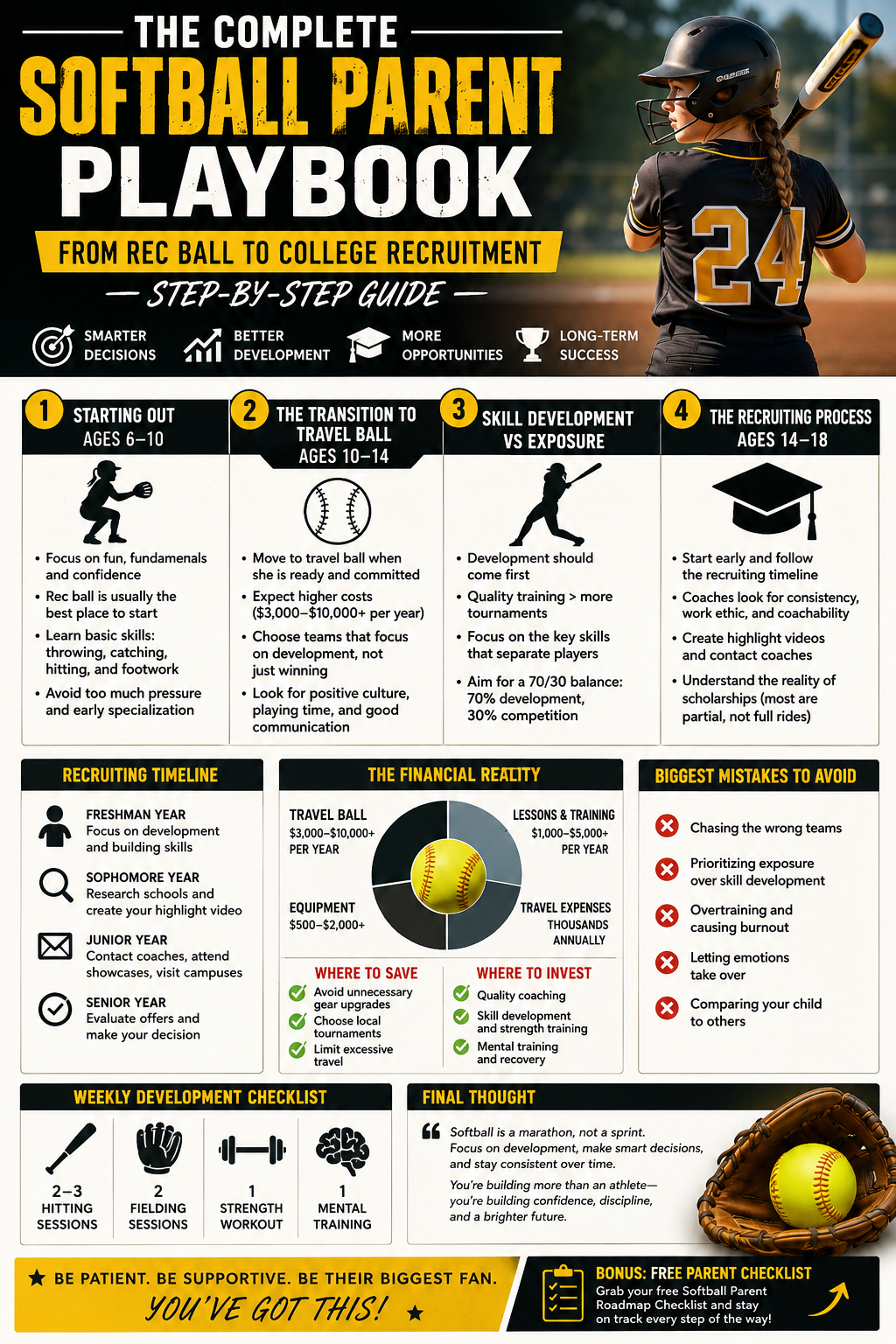
The Complete Softball Parent Playbook: From Rec Ball to College Recruitment (Step-by-Step)
What Every Softball Parent Needs to Know
If your daughter plays softball, you’ve probably already realized something…
This isn’t just a game. It’s a journey.
And for most parents, it’s confusing, expensive, and full of conflicting advice.
- Should she play rec or travel ball?
- When should you invest in private lessons?
- How does recruiting actually work?
- Are you wasting money on the wrong things?
The truth is, most softball parents are guessing their way through the process—and that leads to wasted time, money, and missed opportunities.
This complete softball parent playbook will walk you step-by-step from beginner leagues all the way to college recruiting, so you can make the right decisions at every stage.
Stage 1: Starting Out (Ages 6–10)
Focus on Fun, Fundamentals, and Confidence
At the early stages of youth softball, your number one priority should NOT be winning games.
It should be:
- Building confidence
- Learning basic fundamentals
- Developing a love for the game
This is where many parents make their first mistake—they rush into competitive environments too early.
Rec Ball vs Travel Ball: What’s Best?
For most players under age 10, recreational leagues are the best place to start.
Why?
- Less pressure
- More playing time
- Opportunity to learn multiple positions
- Lower cost
Travel ball at this age often focuses too much on winning instead of development.
What Skills Matter Most Early On
Instead of worrying about elite coaching or expensive gear, focus on:
- Throwing mechanics
- Catching fundamentals
- Basic hitting technique
- Footwork
Common Parent Mistakes at This Stage
- Spending too much money on equipment
- Comparing your child to others too early
- Putting pressure on performance
- Jumping into travel ball too soon
Stage 2: The Transition to Travel Ball (Ages 10–14)
When Should You Move to Travel Softball?
This is one of the most searched questions in youth softball—and for good reason.
You should consider travel ball when:
- Your daughter shows strong interest and commitment
- She has solid fundamentals
- She wants to compete at a higher level
The Truth About Travel Ball
Travel softball can be a great opportunity—but it’s also where things get expensive and complicated.
Average yearly costs can include:
- Team fees
- Uniforms
- Tournament entry fees
- Travel expenses (hotels, gas, food)
It’s not uncommon for families to spend $3,000 to $10,000+ per year.
How to Choose the Right Team
Not all travel teams are equal. In fact, choosing the wrong one can slow development.
Look for:
- Coaches who focus on development, not just winning
- Equal playing time (especially at younger ages)
- A positive team culture
- Clear communication
Red Flags to Watch Out For
- Coaches who only play the same few players
- Constant team turnover
- Poor communication
- Focus only on tournaments, not training
Stage 3: Skill Development vs Exposure
The Biggest Mistake in Youth Softball
Most families believe that more tournaments = more opportunities.
That’s not true.
If your daughter isn’t skilled enough, exposure won’t matter.
Development Should Come First
Focus on:
- Strength and conditioning
- Repetition and practice
- Private or small group lessons (when appropriate)
- Consistent training routines
The 70/30 Rule
A good balance for most players:
- 70% development
- 30% competition
Key Skills That Separate Players
- Consistent hitting
- Defensive reliability
- Game awareness
- Mental toughness
Why Training Matters More Than Travel
You don’t get recruited for how many tournaments you play.
You get recruited for how good you are.
Stage 4: The Recruiting Process (Ages 14–18)
Understanding the Recruiting Timeline
Here’s a simple breakdown:
Freshman Year
- Focus on development
- Start building skills and confidence
Sophomore Year
- Begin researching schools
- Create highlight videos
Junior Year
- Contact college coaches
- Attend showcases
- Visit campuses
Senior Year
- Finalize offers
- Make your decision
What Coaches Are Really Looking For
- Consistency
- Work ethic
- Coachability
- Athletic ability
- Academic performance
How to Contact College Coaches
Most players miss opportunities because they don’t reach out.
A simple email should include:
- Player name, position, graduation year
- Stats and achievements
- Highlight video link
- Upcoming tournament schedule
The Truth About Scholarships
Many parents believe softball scholarships will pay for everything.
In reality:
- Most are partial scholarships
- Opportunities vary by division (D1, D2, NAIA, JUCO)
- Academics often play a big role
Stage 5: The Financial Reality of Softball
What You Can Expect to Spend
Over the course of a softball career, families may spend:
- Equipment: $500–$2,000+
- Travel ball: $3,000–$10,000 per year
- Lessons and training: $1,000–$5,000 per year
- Travel expenses: thousands annually
Where to Save Money
- Avoid unnecessary gear upgrades
- Choose local tournaments when possible
- Focus on development instead of constant travel
Where to Invest
- Quality coaching
- Skill development
- Strength training
- Mental training
Stage 6: The Biggest Mistakes Softball Parents Make
1. Chasing the Wrong Teams
Bigger names don’t always mean better development.
2. Prioritizing Exposure Over Skill
You can’t skip the development phase.
3. Overtraining and Burnout
Kids need balance. Too much pressure leads to burnout.
4. Letting Emotions Take Over
Softball is emotional—but parents must stay grounded.
5. Comparing Your Child to Others
Every player develops at a different pace.
Stage 7: Your Simple Softball Game Plan
Step-by-Step Roadmap
Ages 6–10
- Focus on fun and fundamentals
- Play rec ball
Ages 10–14
- Transition to travel ball if ready
- Begin structured training
Ages 14–18
- Build skills and exposure strategically
- Start recruiting process early
Weekly Development Checklist
- 2–3 hitting sessions
- 2 fielding sessions
- 1 strength workout
- 1 mental training session
Monthly Focus
- Evaluate progress
- Adjust training
- Set new goals
Final Thoughts: Play the Long Game
Softball is a marathon, not a sprint.
The families who succeed aren’t the ones who spend the most money or chase every opportunity.
They’re the ones who:
- Focus on development
- Make smart decisions
- Stay consistent over time
If you follow this playbook, you’ll give your daughter the best possible chance to succeed—not just in softball, but in life.